This is it—the infamous “FEMA manual” James Fetzer just can’t stop gushing about. Don’t worry if you find it disappointingly underwhelming. That’s probably because it’s an obvious amateur forgery. But before we dive into the weeds, let’s start with a little background.
“Nobody Died At Sandy Hook” Afterword By: Nick Kollerstrom
“No-one has been able to get into the Sandy Hook elementary school to verify if there are any bullet-marks, bloodstains etc” pg. 209
No one? Well—except law enforcement, EMS, crime scene investigators, medical examiners, school staff, and the parents of murdered children. Surely Nick Kollerstrom isn’t genuinely baffled that an elementary school where twenty-six people—including twenty five- and six-year-olds—were slaughtered wasn’t opened up for public walkthroughs.
That said, if Kollerstrom were actually interested in seeing bullet impacts and blood evidence (he isn’t), he could simply consult Detective Walkley’s crime scene documentation, all of which is publicly available in the final report:
“Nobody Died At Sandy Hook” Epilogue By: Dennis Cimino
This chapter’s author, Dennis Cimino, manages to out himself as an Obama “birther” by the second paragraph—because of course he does. Not just any birther, either, but a particularly gullible one. The claim that Barack Obama attended school under the name “Barry Soetoro” originated as an April Fool’s joke in 2009. That this is still being repeated years later, in a published book, tells you exactly what level of rigor you’re dealing with here. Buckle up.
“Nobody Died At Sandy Hook” Chapter Twelve By: Sterling Harwood
“Carver said one can control the situation better by using instead photographs of the dead to identify the victims, depending on the photographer. Snopes.com said that what Carver meant was that one can use a photograph of the face to identify the victim without showing wounds to the body of a child. This, however, hardly depends on the photographer; this depends instead on the shooter and where he shot the child. If the shooter shot the child in the face or even shot the identifying features of the child’s face off, then the photographer wouldn’t matter one little bit.” pg. 188
Much of this is beside the point. Even if it weren’t, it wouldn’t matter, because photographs are only one of several methods used to identify victims. Harwood’s fixation on this issue ignores how victim identification actually works in real-world mass-casualty investigations.
Professional crank James Fetzer and his band of loopy dipshits place an inordinate amount of faith in Twitter posts, citing them repeatedly throughout the despicable Nobody Died at Sandy Hook. In Chapter Five, “Vivian Lee” leans heavily on a handful of confusingly time-stamped tweets—artifacts of a well-documented Twitter bug I’ve already addressed at length—to support one of her “top ten reasons Sandy Hook was an elaborate hoax.” On page 67, under “4. There was foreknowledge of the event,” she writes:
In addition, tweets about the shooting began before it occurred, a tribute was apparently uploaded one month before the event, and web pages honoring the victims, including a Facebook page R.I.P. Victoria Soto, were established before they had “officially” died.
A great deal of emphasis is also placed on a single, utterly mundane tweet from Sandy Hook Elementary principal Dawn Hochsprung’s Twitter account. Posted on October 17, 2012, it shows students participating in the school’s annual evacuation drill. Despite looking nothing like the chaos of December 14—an observation that should shock precisely no one—this image is nevertheless presented as “proof” that the massacre was merely a drill:
Safety first at Sandy Hook… It's a beautiful day for our annual evacuation drill! pic.twitter.com/F1121xE7
This claim only works if the authors accept Hochsprung’s Twitter account as legitimate. And they clearly do—because tweets from the morning of December 14 could not possibly serve as “evidence” unless Fetzer and company believed Twitter reliably displays authentic, user-generated content.
That commitment has consequences.
If Dawn Hochsprung’s Twitter account is real—and it must be, for their argument to function—then everything on her timeline from September through December 2012 must also be real. And what those posts show is not a shuttered building or an abandoned set, but a busy, fully operational elementary school: classrooms full of students, teachers collaborating, assemblies, performances, professional development, fundraisers, book fairs, and seasonal events.
That reality alone collapses Fetzer’s central claim that Sandy Hook Elementary had been closed and unoccupied since 2008—a claim upon which the entire conspiracy depends.
Unsurprisingly, the book makes no mention of Hochsprung’s Twitter timeline beyond the evacuation drill photo. Instead of linking directly to her account, the authors cite their own blog posts about the image. For example, on page 96:
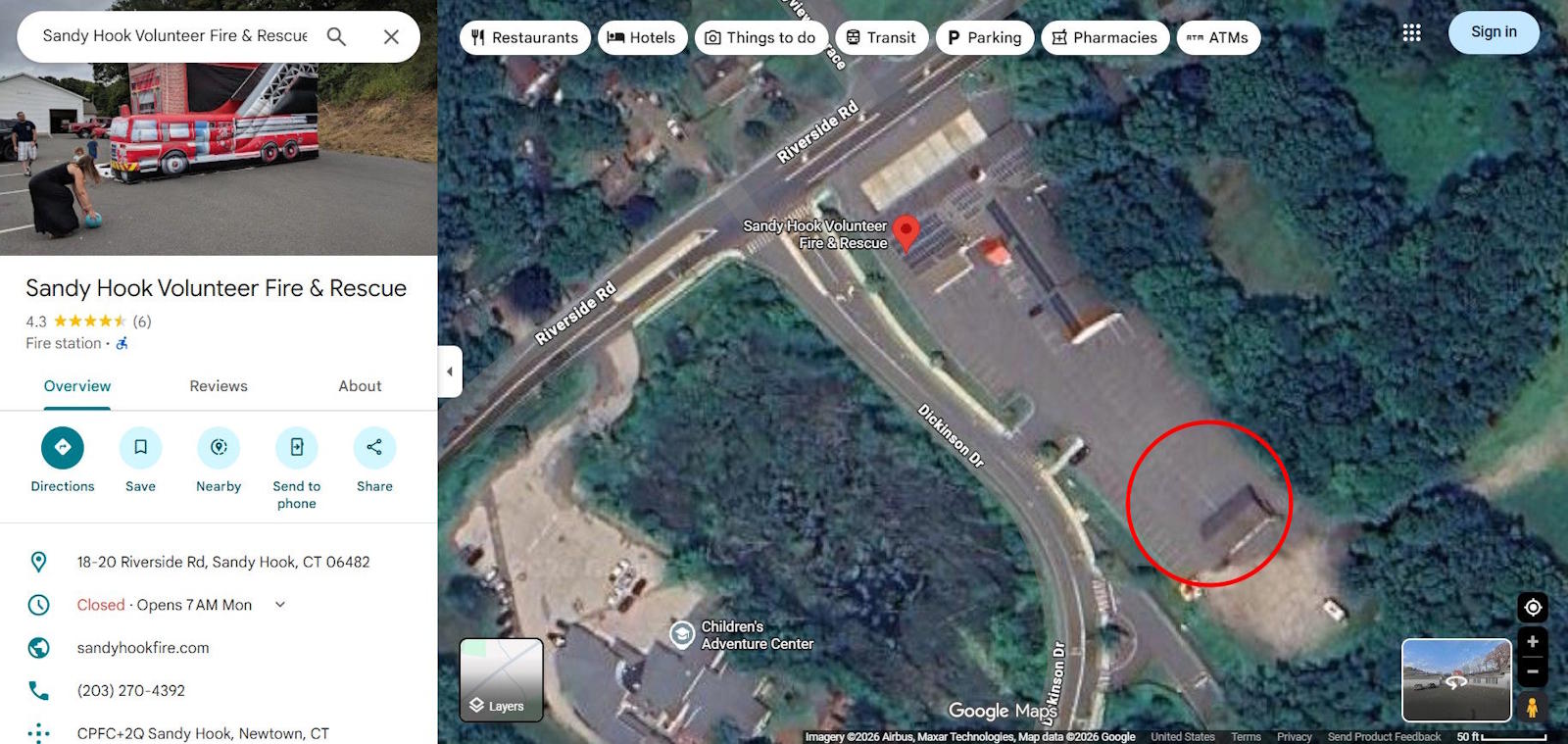
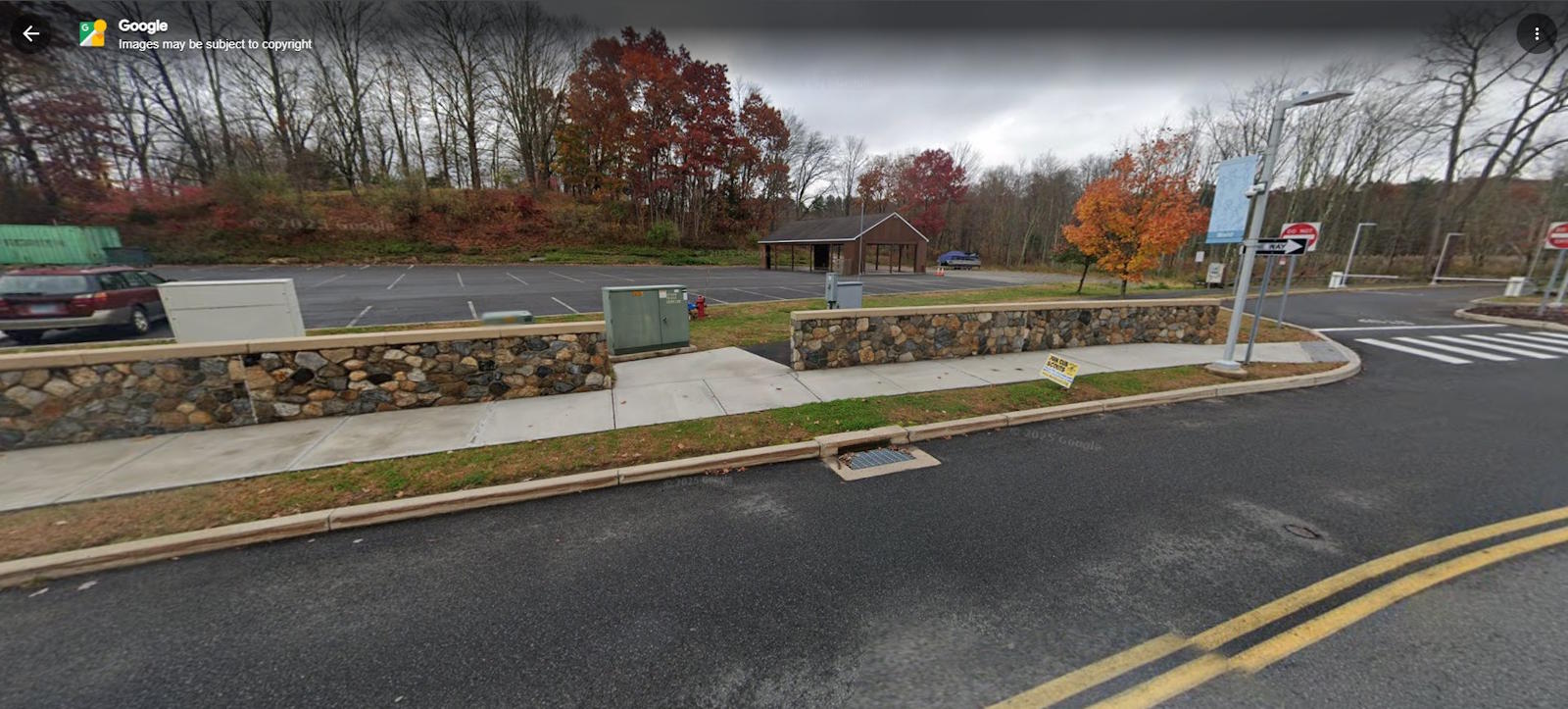
They claim the scenery in one drill photo doesn’t match the scenery in another. This is a manufactured problem. The evacuation photos were taken just outside Sandy Hook Elementary’s front entrance—where Shannon Hicks was standing when she took them—while the fire drill continued behind the Sandy Hook Volunteer Fire & Rescue building, where the students ultimately walked, lined up, and were photographed for Hochsprung’s tweet. The structure visible behind the children in Hochsprung’s photo is the same structure visible behind the firehouse on Google Maps—a fact that’s obvious once you bother to look:
Not everything involving the school happens in one tightly cropped patch of pavement.
The more important question is why the original source is never provided. Why not link directly to Hochsprung’s actual Twitter timeline?
Because they can’t. The moment readers see the full feed—weeks of mundane, verifiable posts showing classrooms full of students, staff events, assemblies, rehearsals, and daily school life—the “closed since 2008” narrative disintegrates instantly. Selective screenshotting is the only way the claim survives.
On October 9, 2012, Hochsprung tweeted a photo from a Pathways to Common Core conference. While the image itself isn’t inside the school, the event is independently corroborated by the November 2012 Newtown Public Schools Superintendent’s Newsletter, which includes the following statement from survivor Natalie Hammond:
“Nobody Died At Sandy Hook” Chapter Eleven By: James Fetzer and Kelley Watt
When I saw the title of this chapter—“Are Sandy Hook skeptics delusional with ‘twisted minds’?”—I thought, Perfect. Easiest chapter yet. I’ll just write “yes”—or “yes, of course,” if I’m feeling loquacious—publish it, and move on to Chapter Twelve.
Unfortunately, there are actual claims being made here. Most are the same recycled nonsense we’ve already slogged through in earlier chapters, but a couple of new wrinkles are tossed in for variety.
“Nobody Died At Sandy Hook” Chapter Ten By: “Dr. Eowyn” (aka Maria Hsia Chang) and James Fetzer
Chapter Ten is an interesting read — not because it suddenly delivers anything resembling compelling evidence (spoiler: it absolutely does not), but because its central claim was thoroughly debunked years ago by Metabunk, Snopes, USA Today, and plenty of others. To their credit — sort of — the authors even admit this right in the opening paragraph. And yet, for reasons known only to them, the chapter keeps going. What follows is James Fetzer and Maria Chang tripping over themselves in an attempt at a rebuttal that basically amounts to “nuh-uh.” Gripping stuff.
As demonstrated in Parts One, Two, and Three, there is overwhelming evidence that Sandy Hook Elementary School was open and fully operational when Adam Lanza—and Adam Lanza alone—entered the building and murdered twenty-six people. Throughout this series, I have deliberately limited myself to the same exact set of crime-scene photographs that deniers repeatedly cite as proof that the school supposedly closed in 2008 and sat abandoned until it was resurrected four years later for a staged event. Even under those constraints, their claims collapse almost immediately.
And this is before even touching the extensive body of official records—maintenance logs, budgets, staffing documents, board of education materials, and contemporaneous reporting—unearthed and cataloged by me as well as researchers at Metabunk, Sandy Hook: Focus on Facts, and elsewhere. That broader documentary record will be addressed in due time. For now, the photographs alone are more than sufficient.
This entry focuses on another overlooked but deeply inconvenient problem for the “closed since 2008” narrative: the presence of SMART Technologies equipment inside the school. SMART Boards, SMART projectors, and related interactive classroom technology appear throughout Sandy Hook Elementary, including in multiple classrooms and the library, as documented in the official video walkthrough and even acknowledged—though never seriously grappled with—in Chapter Eight of Nobody Died at Sandy Hook.
For the sake of clarity and specificity, I’ll focus on two classrooms in particular: Classroom 6 (special education) and Classroom 8 (first grade). The technology visible in these rooms is not only inconsistent with a school abandoned in 2008—it directly contradicts the timeline deniers insist upon and raises questions they never even attempt to answer.
Is there a more exciting subject than trees? Of course not.
Throughout Chapter Eight of Nobody Died at Sandy Hook, Allan Powell—an Australian conspiracy theorist with no apparent background in botany, climatology, or northeastern American winters—leans heavily on the claim that the crime-scene photographs from Sandy Hook Elementary School were not taken in December at all, but sometime in the fall. His preferred window shifts slightly from page to page, but generally lands on “late October or early November.” Maria Hsia Chang (“Dr. Eowyn”) echoes this same claim in Chapter Two, Six Signs Sandy Hook Elementary School Was Closed.
For the uninitiated, Reddit is a user-driven content aggregator broken up into communities called subreddits. Each subreddit centers on a specific interest, and collectively they cover just about everything imaginable—news, politics, culture, hobbies, and plenty of nonsense. There are thousands of them. Based on subscriber count, the main conspiracy subreddit currently ranks as the 108th most popular on the site, nestled comfortably between the NBA and anime.
Sandy Hook denial is, unfortunately but predictably, a popular topic there. As a result, even a clueless doofus like James Fetzer manages to receive regular praise—along with occasional scorn, since conspiracy theorists love eating their own almost as much as they love conspiracies.
While it never really found a large audience, the conspiracyAMA subreddit was created as a spin on Reddit’s wildly popular AMA format, typically used by celebrities or public figures to interact with Reddit’s enormous userbase. The idea was to give conspiracy personalities a “safe space” to answer questions without immediate ridicule. Though the subreddit ultimately paled in comparison to its inspiration, it did manage to host one of the most disastrous AMAs I’ve ever seen—right up there with Woody Harrelson’s legendary meltdown.
The guest of honor was, of course, bloated clown James Fetzer, fresh off his Amazon ban and eager to milk his allotted fifteen minutes of relevance.
I strongly recommend setting aside some time and reading the AMA in its entirety. It eventually ballooned to 371 comments before finally running out of steam, and it’s an incredible document. What follows, however, are some of my favorite moments—packed with Fetzer’s bald-faced lies, furious backpedaling, and his predictably asinine takes on other subjects (especially Jews).
All responses are from James Fetzer, transcribed by the moderator. This may not mean much if you’re unfamiliar with Reddit, but it’s worth noting that Fetzer’s answers were rated so poorly by users that many of them were automatically hidden from view. That’s how badly things went for poor James… in his own AMA.
Still, don’t feel too bad for him. Fetzer seems convinced it went swimmingly. Seriously. Just take a look at this Facebook post: