
“Nobody Died At Sandy Hook”
Chapter Three
By: James Fetzer
This chapter revisits Wolfgang Halbig’s cringe-worthy presentation before the Connecticut Freedom of Information Commission during his first FOIA hearing. It’s essentially a recap of a performance that managed to waste a remarkable amount of time and money while accomplishing absolutely nothing.
C.W. Wade of Sandy Hook Facts summed up the debacle perfectly:
Wolfgang Halbig’s spent about $20,000 raised through his charity, Sandy Hook Justice, for two days worth of hearings. He was awarded no documents and the majority of his complaints where dismissed in their entirety. It should also be noted that the documents Halbig obtained at a cost of about $20,000, Sandy Hook Facts obtained for under $100.
Ouch.
“Among our most important discoveries has been the FEMA manual for the Sandy Hook event (Appendix A), which specifies that a rehearsal will be conducted on December 13, 2012, with the event going ‘LIVE’ on the 14th, which explains why Wolf has been unable to obtain information about the Port-A-Potties, which on its face seems very obscure, but where releasing the documents he has requested would reveal that they were delivered on the 13th, which blows the cover for the whole event.” pgs. 39-40
The so-called “FEMA manual” is an obvious, embarrassingly amateurish forgery, as thoroughly documented here and here. It’s not a classified planning document—it’s a slapdash piece of conspiracy fan fiction that doesn’t survive five minutes of basic scrutiny.
As for the supposedly mysterious timing of the portable toilet deliveries, anyone genuinely interested in the answer can simply watch the police dashcam footage from that morning. The toilets are shown being delivered and set up in real time:

Note the clearly visible date and timestamp: 13:28:11 (1:28 PM) on 12/14/12.
And if the toilets had actually been delivered the day before—as Halbig and company insist—they would appear in early aerial photos of the school’s parking lot:

They don’t. Unsurprisingly, they do appear in aerial photos taken later that same day:

That alone settles the issue. The toilets were not delivered prior to the shooting. All Halbig needed to figure this out was a few publicly available photos and the most basic application of logic—both of which, once again, appear to have been in short supply.
“One of Wolf’s successes has been to gain access to dozens and dozens of photographs taken of the school the day after the alleged shooting.” pg. 40
Yes, Halbig “gained access” to these photos by doing what anyone else could do: downloading the crime scene images that were publicly posted on a dedicated website as part of the state’s final report released in December 2013—years before his disastrous FOIA hearing. Quite the achievement. What’s far less impressive is that he apparently couldn’t even be bothered to download the accompanying videos, opting instead to wait for someone else to upload them to YouTube so he—or, more likely, one of his lackeys—could scrape a few screenshots.
There are dozens of photos in this section, all included in the final report. I won’t waste time cataloging every one of them, because any reasonable adult can see they depict an aging but functional public elementary school.
That said, a few of Halbig’s captions are too ridiculous to ignore. You can’t make this stuff up.

Rusted hinges on an exterior emergency exit door? Case closed, everyone. Clearly no learning could ever take place in a building with rusted hinges on an exterior door.

Bent blinds? The horror. Shut it down.

A rusty outdoor storage shed behind the school—an area students aren’t even allowed to access? Obviously proof that Sandy Hook was abandoned. Because if the school were operational, administrators would surely prioritize refinishing the rusty edge of a metal utility box instead of, say, educating children. Public schools are famously flush with money, after all.

Then there’s the air conditioner.
Halbig seemingly questions the presence of an air conditioner in December and asks why a “broken” window would be replaced with an AC unit instead of a wooden board. Due to the type of windows used throughout the school, air conditioners were clearly semi-permanent fixtures in rooms where they were needed, including conference rooms that saw year-round use, such as Conference Room 9:
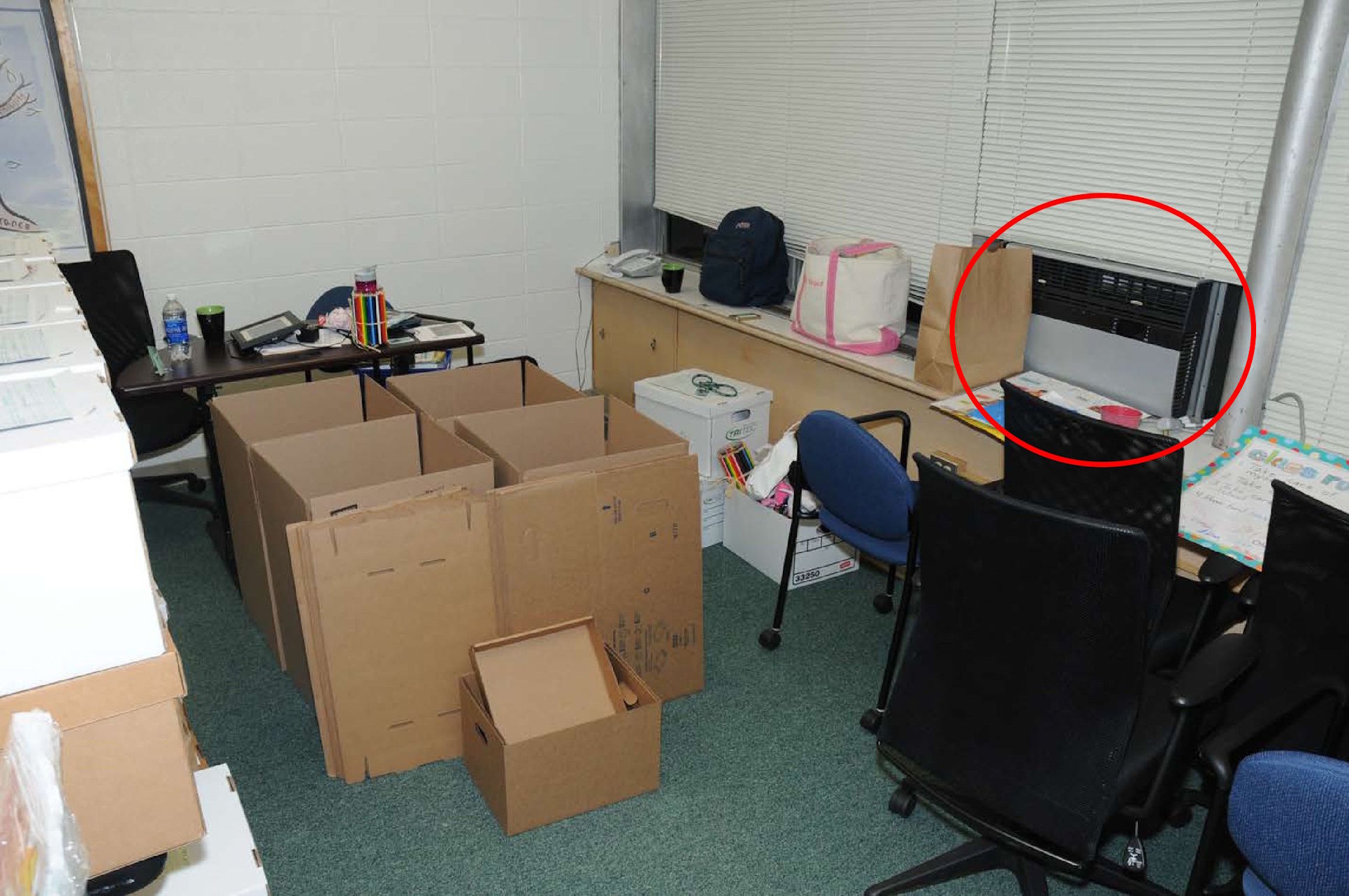
As for Conference Room 20—where teachers are often said to have “broken” a window to escape—Halbig simply assumes the window in question must have been the one containing the air conditioner. There is no evidence for this assumption whatsoever. In fact, the underlying accounts are far less definitive than he suggests.
Two of the teachers inside Conference Room 20, in their police interviews (00006441.pdf and 00251430.pdf), describe climbing through a window and make no mention of breaking anything. The teacher interviewed in 00006441.pdf is explicit: “[redacted] opened a window in the room she was in, climbed through it and ran from the school.” While that report does not explicitly name Conference Room 20, the number of teachers involved aligns, as does the detail about one teacher smelling gunpowder, strongly indicating it refers to the same group.
Only two accounts mention a window being broken. One (00002095.pdf) is firsthand, stating: “They began to hide but broke a classroom window and crawled out.” The other (00005444.pdf) is secondhand, relayed by a male teacher who had already left the room—and likely exited the building entirely—before the remaining female teachers allegedly broke any windows. He later reported what he was told when the group reunited at a nearby Subway: “[redacted] said that after the incident he had met up with one of the female teachers… who told [redacted] that she and another female teacher had broken out a glass window in the room, crawled out through the window, and ran from the school to escape.”
At this point, it’s worth examining the interior of Conference Room 20 using a screenshot from WDMCS_School_Interior_4_of_5.wmv, a video walkthrough filmed two days after the shooting. In that image, the side and rear of the air conditioner are fully visible from inside the room. This strongly suggests that no wooden board or other filler occupied the space beside the unit at the time. In other words, there was an openable or otherwise removable section immediately adjacent to the air conditioner.
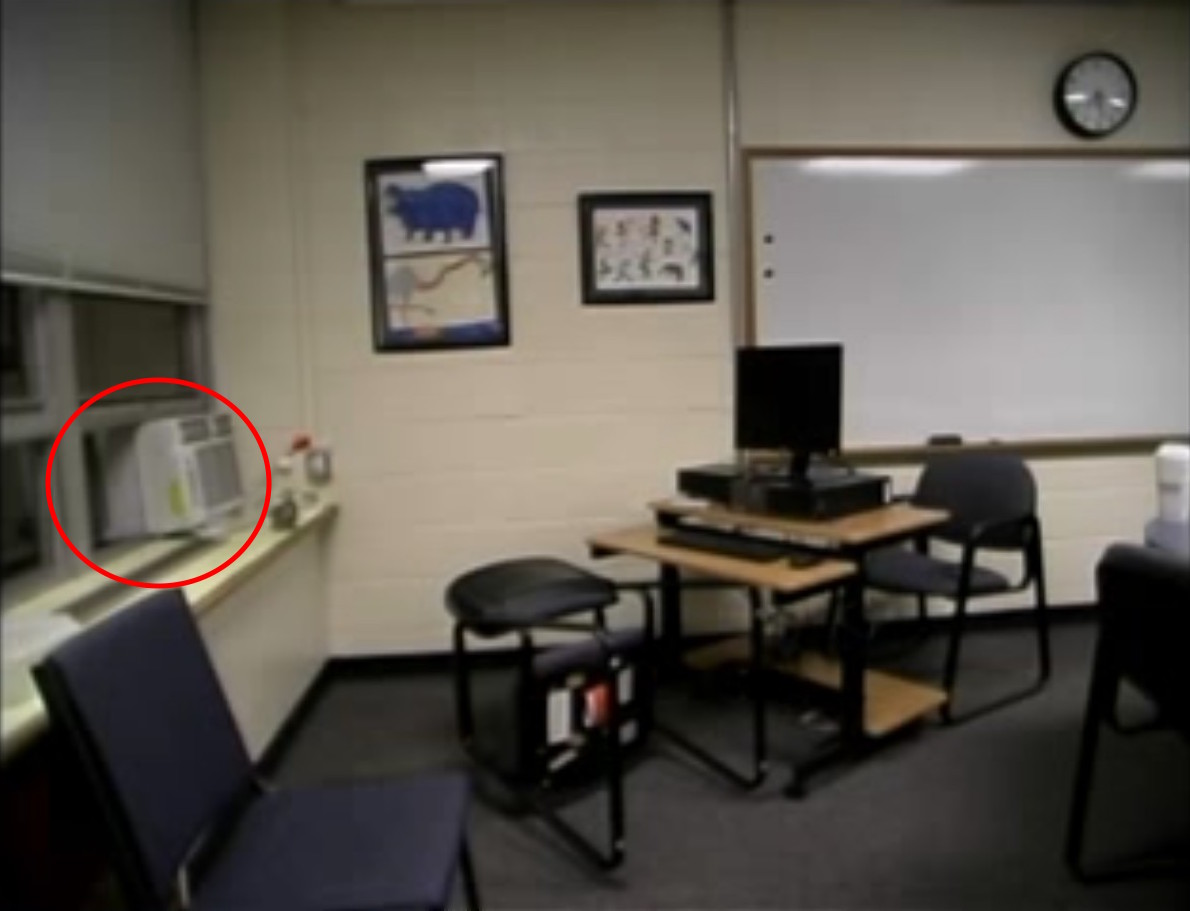
This detail could help reconcile the differing accounts. It’s entirely plausible that the teachers escaped through the space next to the air conditioner after removing or breaking whatever occupied it. That scenario could explain why some accounts describe “opening” a window while others describe “breaking” one, without requiring that an entire pane of glass be shattered or the air conditioner itself be removed.
Farr’s crime scene photos—Halbig’s preferred reference—were taken after the shooting, during a period when workers were boarding up windows and clearing the building. Yet in WDMCS_School_Interior_4_of_5.wmv, as seen above, the air conditioner in Conference Room 20 is clearly visible in the same window, pushed to the same side. This strongly suggests the unit was never removed.
Taken together, the evidence supports several reasonable possibilities: a different window may have been broken and later secured, the escape may have involved the smaller section adjacent to the air conditioner, or the teachers may simply have opened one of the operable windows and climbed out—leaving no broken glass behind. None of these scenarios require staging, and none support Halbig’s assumption that the air conditioner window must have been broken.
Once again, the problem isn’t missing evidence—it’s Halbig’s habit of selecting the most dramatic interpretation and presenting it as settled fact.

Is this guy for real? Halbig had months to prepare for his big FOIA hearing, and he couldn’t even figure out that these are composting bins.
The one on the far right looks very much like a Good Ideas 7-cubic-foot Compost Wizard Jr.—something that might have been obvious if he’d bothered to notice, say, the surrounding gardening equipment. Or the fact that Sandy Hook Elementary’s composting program was openly discussed in a local newspaper months before the shooting. For example, this article from July 20, 2012, notes:
There is a schedule put in place for different students and families to come to the school throughout the week to water and weed the garden.
Weeds taken from the garden are put in a compost heap, which is part of a third grade project.
And this wasn’t some last-minute addition, either. Sandy Hook had been planning a composting program as far back as 2010, as reported by The Newtown Bee:
Next year a composting project may also be added, similar to Hawley’s program, but both Ms Hammond and Ms Taylor said parent volunteers would be needed.
Yet despite openly admitting he has no idea what he’s looking at, Halbig somehow just knows—deep down in his not-insignificant gut—that these bins “look unsafe.” Unsafe how, exactly? Are we supposed to imagine a child wandering unsupervised into the courtyard, climbing into a 22-inch-deep compost container, and then—against all odds—screwing the lid closed, even though it can only be fastened from the outside due to the threading and placement of the handles?
Once again, ordinary, well-documented features of a functioning elementary school are transformed into “evidence” of staging, simply because Halbig can’t be bothered to do even the most basic research.

This one—unsurprisingly—is deceptive, and almost certainly intentional. At first glance, peering into Classroom #6 from this doorway and at this specific angle, the room might appear somewhat cramped. In Halbig’s version, that impression is reinforced by the strategic placement of a text box directly over the most open, uncluttered area—because when you’re trying to sell a narrative, you don’t want your audience seeing that part.
Below is the same photograph sourced directly from Tranquillo’s backup crime-scene photos (page 78), presented without annotations. With nothing obscuring the view, it becomes clear just how much more floor space is actually visible from this angle alone—something the annotated version carefully avoids showing.
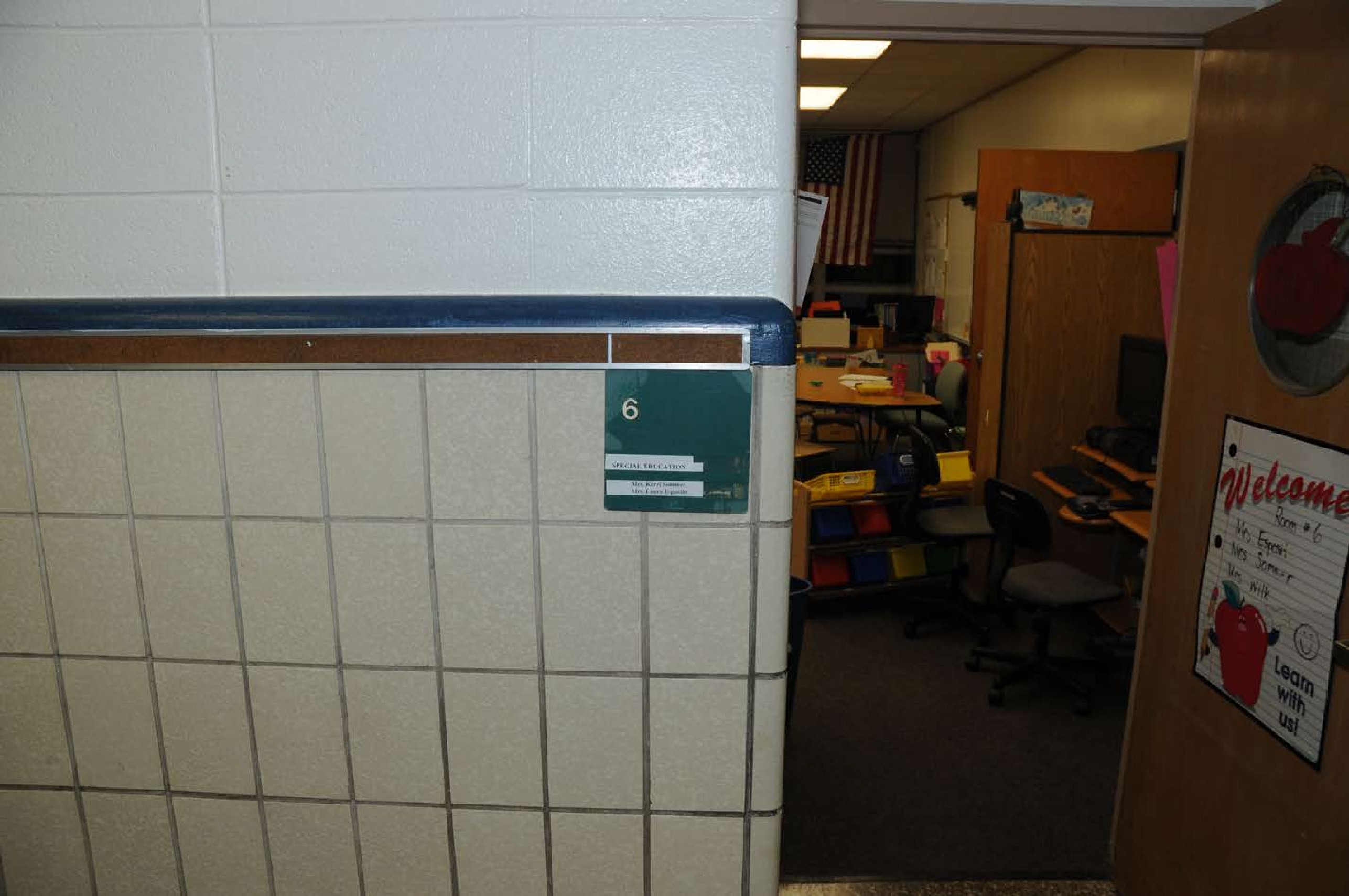
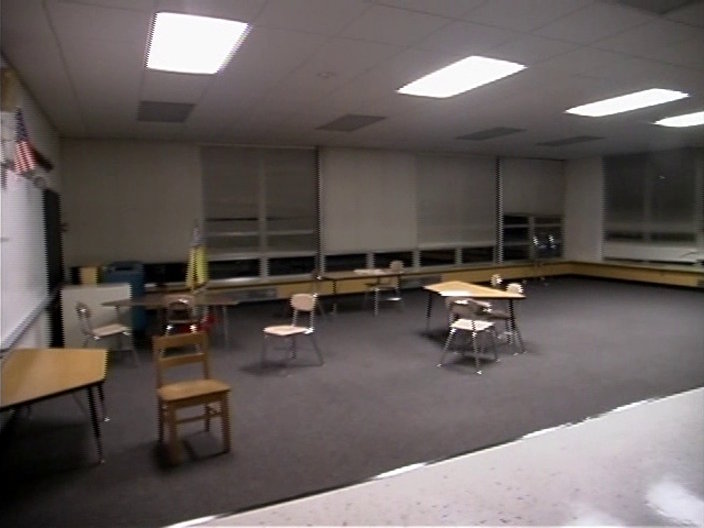
For additional context, here is a panoramic shot of Classroom #6 from the same set of crime-scene photographs. When you’re not cherry-picking angles or covering open space with text boxes, the room is plainly neither cramped nor cluttered.

As the full view shows, there is ample clean, open space throughout the room. It’s anything but cluttered.

Why would anyone need to open this refrigerator at all? It is clearly unplugged.

Yes, you read that correctly. Wolfgang Halbig actually pointed to “strangely painted or smeared cabinets” as supposed evidence that Sandy Hook Elementary School was non-operational on December 14, 2012. This is the level of “investigation” people were apparently sending their Social Security checks to bankroll.
Never mind that what appears to be sponge painting and faux finishes were common in elementary schools at the time—often done by parents, volunteers, or staff precisely to make classrooms feel more welcoming to children. No alternative explanation is offered, no attempt at verification is made; the cabinets merely look weird to him, and that’s apparently enough to suggest a massive hoax.
When aesthetic choices are being treated as forensic red flags, it becomes hard to take any of the surrounding claims seriously.

Now, anyone who has ever used one of these paper towel dispensers knows that the amount of towel sticking out tells you almost nothing about how many towels are actually inside—especially with motion-activated, touchless models. Towels often bunch up internally, or the last person yanks them off in a way that leaves nothing but a ragged shred barely within reach, even when the dispenser itself is far from empty.
Second, this photo shows the exterior bathroom door for Room #2, which is labeled as “possible day care” on the the school’s floor plan, while the placard outside the door itself reads “PROBE.” Additionally, a sign posted on a rear vestibule closet door identifies the space as a “parent pickup” room, presumably for kindergarten students.
One of the very few other images of Room #2 included in the crime scene photographs—page 679 of Walkley’s set—shows the room to be almost entirely empty:

A clearer look inside the room—a screenshot from WDMCS_School_Interior_1_of_5.wmv—reinforces this interpretation. The space is sparsely furnished, containing only a handful of tables and chairs, with none of the instructional materials, decorations, or permanent fixtures you’d expect in a regularly used classroom. If anything, this strongly supports the idea that Room #2 did, in fact, function as a parent pickup area.
Yet Halbig eagerly fixates on a supposedly empty paper towel dispenser and a “dirty wall” (because, apparently, real elementary schools are pristine at all times), while ignoring multiple obvious signs that this space was, in fact, being used—even if only occasionally. Visible in the room are a can of air freshener, a bottle of soap, hand lotion, and a thermostat reading 70°F in mid-December—clear indications that the building’s heating system was on and the space was functional. If the school had truly been abandoned for years, it’s hard to imagine anyone bothering to keep it so comfortably warm.
And let’s not forget: numerous other paper towel dispensers throughout the school do have towels clearly visible. Multiple examples appear in the very same source file—Gunsalus – interior doors.pdf. Funny how those didn’t make it into Halbig’s ever-growing pile of “evidence.”


That last image even shows used paper towels sitting in the trash. Apparently, whoever “staged” the school thought of everything… except cleaning up just enough to fool Wolfgang Halbig, of course.
But if anyone really found themselves in desperate need of paper towels in this allegedly abandoned school, I think I might know exactly where to look:

This looks promising. Let’s take a peek inside:

Jackpot!

Here we go again—another case of Halbig encountering an object he doesn’t recognize and immediately declaring it “suspicious.”
The real mystery isn’t the device—it’s how Halbig, a self-described expert in school safety and security, an alleged former Director of Safety and Security for Seminole County Public Schools, and a figure who has parlayed those claims into minor celebrity status within the Sandy Hook denial ecosystem, failed to identify a basic motion detector.
The device is a DS794Z motion detector manufactured by Detection Systems, Inc.—a completely ordinary piece of security hardware commonly installed above doorways to monitor movement.

In other words, this isn’t evidence of staging, secrecy, or anything nefarious. It’s evidence that Halbig either didn’t know what he was looking at, didn’t bother to find out, or preferred to let ignorance masquerade as “investigation.”

Halbig captions this image—taken from page 751 of Walkley’s crime scene photographs—in a way that leads the reader to believe the most recent evacuation plan available in the school was from “the previous school year, 2011–2012.” What he does not disclose—despite drawing from the very same photo set—is that evacuation plans for the 2012–2013 school year were clearly posted elsewhere in the building.
Specifically, updated evacuation plans are posted outside Room 10 (Soto) and Room 8 (D’Amato) on pages 747 and 749, respectively, of the very same document:


While the year on Room 8’s plan is admittedly harder to read than the one outside Room 10, it is clearly not marked 2011–2012. More importantly, the scene documentation itself resolves any ambiguity. Document 00118939.pdf (part of CFS1200704597) explicitly identifies these as 2012–2013 evacuation plans, dated August 8, 2012—approximately four months before the shooting:

As for the allegedly “outdated” evacuation plan Halbig highlights—entered as Exhibit #82—it isn’t even posted outside a classroom. It is located outside Conference Room 9, not a student classroom at all:

Finally, evacuation plans from 2009 and 2010 were also found elsewhere in the building. This raises an obvious question Halbig never addresses: why would a school that supposedly closed permanently in 2008 contain evacuation plans spanning every year from 2009 through 2013?
Once again, what’s being presented as evidence of something sinister collapses the moment the surrounding documentation—much of it from the exact same source—is examined.

Once again, this is Room #2, labeled as “possible day care” on the floor plan, marked “PROBE” on the hallway placard, and noted as a parent pickup area on a sign posted to another door—though it appears to have been largely unused at the time of the shooting. There is absolutely no indication that this is an actual classroom. If this space were used for day care, you wouldn’t want very young children to be able to lock themselves in the bathroom. Some day care facilities and preschools don’t even bother installing bathroom doors for this very reason.
And let’s not forget: this is the same guy who was worried about children somehow getting trapped in composting bins.

Halbig captions this image as “unsure what this is,” once again completely unashamed of his own ignorance—and, as usual, treating that ignorance as if it were evidence of something nefarious.
What’s shown here is just a network rack—completely ordinary IT infrastructure you’ll find in any school, office,etc. Sandy Hook had more than one of them; there’s another near the front entrance in room 11A-5.
And yes, they almost always look exactly like this. Patch cables and power cords are routinely visible and often purposely left with extra length for maintenance, reconfiguration, or replacement. Anyone with even passing familiarity with IT environments would recognize this scene instantly.
More importantly, there is zero chance students were ever allowed in this room. So clutching pearls over “dangling” cables is meaningless.

According to Halbig, this is “clutter.” Apparently, he expects a building that serves hundreds of children to be spotless at all times. In reality, this looks exactly like what it is: a functioning elementary school music room. Instruments are grouped together in bins, stacked where they’re accessible, and a few items are on the floor—hardly shocking in a space designed for regular, hands-on use by kids. If anything, the room looks organized for instruction, not abandoned or staged.
“The discussion dealt with the consent agenda regarding the Super Bowl permission by Dawn Hochsprung (“the hoax was sprung in the dawn”), documents for which Wolf had requested.” pg. 41
Doing my best to ignore—and move past—the embarrassing wordplay, it appears Halbig was actually stupid enough to introduce the utterly batshit “Super Bowl Choir” conspiracy theory into his FOIA meeting.
How did this go over with the Connecticut FOIA Commission?
Here’s how Sandy Hook Facts summarized that portion of the hearing:
Records Sought: Halbig asks for the consent agenda for Jan. 23, 2013 and supporting documents.
Facts: Newtown provided these documents to Halbig.
Conspiracy Theorist Angle: Many hoaxer conspiracy theorist believe the children who were killed at Sandy Hook Elementary school shooting are magically alive, aged 5-6 years, and sang at the Super Bowl in 2013. These delusional people have published numerous videos and blog posts making such claims.
Halbig has invented a premise that the Consent Agenda for the Jan. 23, 2013 must have had information on sending the Sandy Hook Elementary School Choir to Super Bowl.
Therefore, reasons Halbig, since documents are not present, he did not receive the document.
Commentary: SandyHookFacts believes that if the general population of Sandy Hook Hoax conspiracy theorists get the names of the chorus, the children and their families will be relentlessly stalked and harassed; much like several others associated, even remotely, to that tragedy. Therefore, protecting these minors from Sandy Hook Hoax conspiracy theorists is essential.
In terms of the FOI request. Halbig asked for a specific documents. Halbig received that documents. Halbig’s irrational belief carries no weight outside of the Hoaxer world and certainly carries zero weight in the legal realm.
In this instance, Newtown provided Halbig with his exact request; the consent agenda and attachments. Halbig was unable to grasp the concept that attachments might have a different date than the consent agenda. The commission even tried to explain it to him. These concepts are apparently beyond Halbig’s understanding.
Again, hoaxer attorney L. Kay Wilson offered zero evidence that Halbig did not receive the complete document.
“When asked when the new security system was installed, he stated it was last updated in 2007! This was new information to all researchers and when Wolf was asked why he thought there was a new system, Wolf said every news outlet in America reported that the school had a new system and that the school principal, Mrs. Hochsprung, had sent out letters to parents describing the new security upgrades.” pg. 42
I address the security system in detail in Chapter Five, but the short version is this: there is nothing “new” or mysterious here at all. Sandy Hook’s security system can be traced back to 2006, as documented in Newtown’s Building & Site Improvements section of the Superintendent of Schools’ Annual Report for fiscal year 2007.
Dawn Hochsprung’s letter to parents—so often waved around as evidence of some last-minute upgrade—was not even original to Sandy Hook. It was adapted from Hawley School’s letter describing their strike-plate security system and had been publicly available on Sandy Hook’s website since at least November 2007.
And the claim that “every news outlet in America reported that the school had a new system”? That’s pure invention. If it were remotely true, Fetzer or Halbig could cite even a single example from one of the countless national or local outlets that allegedly covered it. They don’t—because they can’t. It’s yet another assertion made confidently, supported by nothing, and repeated as fact.
“Governor Malloy blundered here, no doubt because he did not want to admit that the person who had warned him ‘something like this might happen’ appears to have been Attorney General Eric Holder, who visited with the governor on November 27, 2012, which was only a few weeks before the event at Sandy Hook would go down. Yet the governor made no effort to warn Connecticut school districts to enhance their security due to an imminent threat. I surmise he was in fact told they were going to take an abandoned school and conduct a drill and present it as real to promote the administration’s anti-gun agenda.” pg. 43
So let me see if I have this straight. According to this book, Sandy Hook Elementary School supposedly closed in 2008 due to a mysterious, never-reported asbestos issue. The shutdown was so discreet that no local media ever noticed—not at the time, not afterward—and reporters continued to cover the school for years as if it were fully open and operating. They published routine stories about school activities, photographed students and staff, and even attended and reported on multiple events held inside the building itself between 2008 and 2012, apparently without realizing they were standing in a long-abandoned structure.
Then, on November 27, 2012, U.S. Attorney General Eric Holder visits Connecticut to announce Project Longevity, a gang-violence reduction initiative focused on New Haven, Bridgeport, and Hartford—not Newtown. During this very public visit, complete with press coverage but somehow no record of this exchange, Holder allegedly pulls Governor Dan Malloy and Lt. Governor Nancy Wyman aside to quietly warn them that there might be a mass-casualty drill somewhere in the state in the coming weeks. Naturally, this hypothetical drill would require an abandoned school that just happens to still look fully operational.
Oh, and all of this is supposed to occur despite FEMA having already released the alleged “manual” for this drill to the public back on October 8. In this version of reality, Malloy then has just two weeks and three days to fully resurrect a supposedly long-abandoned elementary school, stage it convincingly enough to fool parents, students, staff, police, EMTs, journalists, and the entire town of Newtown—and then casually allude to this ultra-secret plot during a press conference, while simultaneously insisting the event was real and describing it as “a tragedy of unspeakable terms.”
Is this seriously the story we’re meant to accept?
Next: Chapter Four: “Shannon Hicks Denies Staging Her ‘Iconic’ Photograph”
Whatever your side in this story is, the death of those children should trigger a stricter gun law in this country period!
You sir are the denier…
Wow! Another incredibly well-researched, extensively sourced and impeccably worded refutation of the material from the death cult! You certainly showed me!
Great article with a very well researched material. Sandy Hook is such a sad event in our history.
I don’t believe it was closed or that the whole thing was a fake. I believe it was a real event and a very sad one. But there is no denying the school was dirty and disorganized and parts of it looked a real mess. Why would you have an unused fridge in a classroom with stuff stacked on it?
There isn’t? Says who? Because I’d certainly deny most if not all of that. Sure, parts of the school appear to be less-than-meticulous, but it’s an elementary school for chrissakes. It’s also a bit unfair to judge how organized and tidy things were based on crime scene photos as many of the children (and adults) were fleeing a gunman. Therefore, things were (understandably) left out of place or strewn about. There’s no better example of this than the crime scene video, which shows unfinished pizza left out in the open in the cafeteria. Of course the school didn’t regularly leave food out; they were clearly in the middle of making it when shooting broke out.
As for the general condition of the school, it was fifty-six years old and it showed its age. Unsurprisingly, the newer expansion built onto the back of the school was in much better shape (because that’s generally how things work). But if you think Sandy Hook is “dirty”, don’t Google photos from inside America’s inner-city public schools as you may have a heart attack.
It was “unused” based on what exactly? Crime scene photos showing stuff sitting in front of the door? And how would you know how long it had been like that?
Any photos showing the refrigerator in Ms. Soto’s room that I could find were taken after investigators had started combing through the school, so it’s entirely possible (and I’d say more than likely) that they placed the items there during the course of their work. In fact, there’s evidence of this in the crime scene video walk-though of the school’s exterior, which was filmed Friday evening. At around 11:30 of the “CDMCS_School_Exterior” video, there’s a clear shot of the fridge in a much different state than it appears in the crime scene photos: nothing more than a purse or a lunch bag in front of it and even more on top.
So it’s clear that the fridge and the area surrounding it had been disturbed before those crime scene photos were taken.
As for the idea that a refrigerator must be “unused” if stuff is stacked on top of it; the top of my fridge is like 20% of my kitchen storage. Literally every house I’ve been in has been the same way. Get real.