
“Nobody Died At Sandy Hook”
Chapter Four
By: James Fetzer
James Fetzer, pushing hyperbole past the point of self-parody, once heralded his warped interpretation of Shannon Hicks’s now-iconic evacuation photographs as a “smoking gun.” Apparently unwilling to relinquish that fantasy, Fetzer has recycled his earlier blog post on the subject, padded it with appropriated images, and stretched the result—paper-thin though it is—into an entire chapter of this book. So what, exactly, does Fetzer believe makes this photograph so supposedly “damning”?
“A little girl is at the front of the conga line of students led by a police woman in uniform. But she is missing in Shannon’s ‘iconic’ photograph.” pg. 47
This observation only sounds incriminating if one ignores the most basic fact staring Fetzer in the face: these are two different photographs, taken moments apart, depicting two separate groups of students being evacuated—one at a time—by Connecticut State Police Detective Rachael VanNess. The children in one image do not appear in the other for the simplest reason imaginable: they are not the same children.
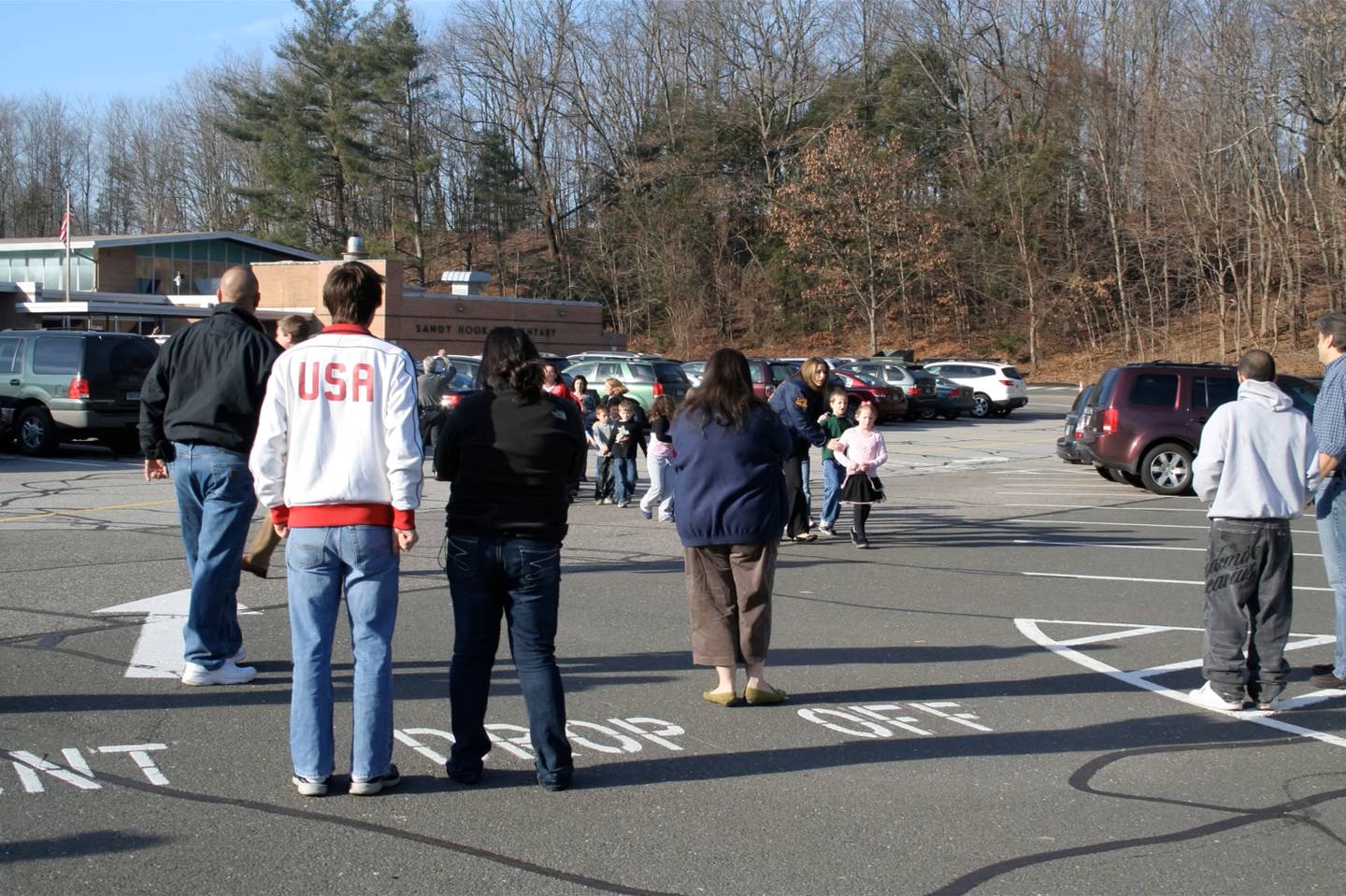
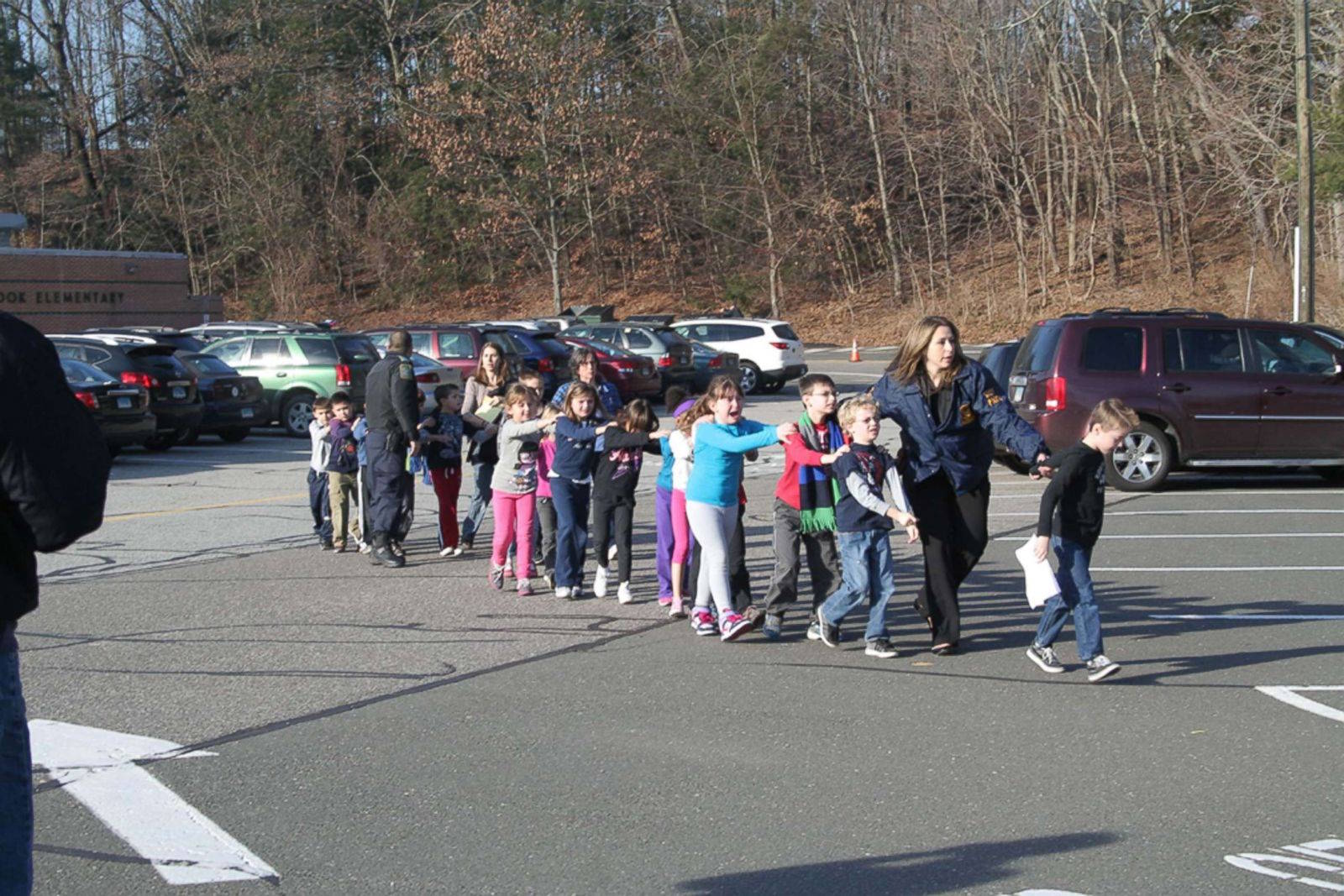
There is no mystery here, no vanishing child, no continuity error demanding conspiratorial explanation. Multiple classrooms were evacuated in stages. Fetzer’s argument collapses the moment one acknowledges the very obvious fact that schools contain more than a single line of students.
In other words, Fetzer’s “smoking gun” turns out to be nothing more than a failure to recognize that two photographs can show two different groups of people. The gun didn’t misfire—it was never loaded to begin with.
I’ve written a more detailed takedown of this nonsense here.
“If this was taken in real time under emergency conditions, how could she have taken more than one?” pg. 47
This implication is not just wrong—it betrays a profound ignorance of how photography actually works. Taking multiple photographs under emergency conditions is not unusual; it is standard practice. Modern cameras can capture multiple images in rapid succession, often within fractions of a second. In chaotic, fast-moving situations, photographers take more photos, not fewer, precisely because events unfold unpredictably.
If Fetzer’s logic were applied consistently, then war photography, disaster journalism, and virtually all crisis documentation would be impossible. By his reasoning, a photographer embedded with troops, covering a bombing, or documenting a natural disaster would be limited to a single frame—an obviously nonsensical conclusion.
Once again, Fetzer mistakes his own misunderstanding for evidence of deception. The problem is not the photographs; it is his refusal to accept that reality does not conform to his conspiracy narrative.
“There should have been around 469 students and 83 faculty and staff to evacuate: Where are they?” pg. 47
So now it’s 469? Back on page twenty-five, James Tracy put the number at 600.

Fetzer may be inching closer to reality, but he’s still wrong. According to the Report of the State’s Attorney for the Judicial District of Danbury on the Shootings at Sandy Hook Elementary School and 36 Yogananda Street, Newtown, Connecticut on December 14, 2012, the school’s enrollment on December 13, 2012, was 489 students.
As for the students and staff “missing” from Hicks’ photographs—there’s nothing mysterious happening. Evacuations didn’t consist of a single line funneling everyone out the front door at once. Students and faculty were guided through multiple exits, at different times, by different staff. Hicks captured only a fraction of that process, focused on the front door and parking lot. Expecting two snapshots to account for every person is not skepticism—it’s a complete failure to understand how evacuations—or basic photography—actually work.
“The ‘iconic’ photograph that was taken by Shannon Hicks, Associate Editor of The Newtown Bee, which Dennis Cimino and I have subjected to an extensive and detailed analysis. It is the only photo we have of any children being evacuated from the school” pg. 48
An “extensive and detailed analysis”? From the same guy who can’t tell two different groups of kids in two different photos apart? Of course, none of this alleged deep dive is actually laid out anywhere in the book.
More importantly, Fetzer and his coauthors absolutely know that other evacuation photos exist. They’ve seen them. Fetzer even references one himself later in the chapter (on page fifty-one). The issue isn’t that these photos are missing or hidden—it’s that they refuse to accept them as real because they blow a hole straight through their narrative. Plenty of evacuation images have been publicly available for years and are already well documented elsewhere. There’s no reason to redo that work here, so I’ll just point anyone who wants to see them to Sandy Hook Facts.
“On the basis of a shadow analysis, Dan concluded that the Shannon Hicks’ photograph was taken at 9:45 AM on 12 November 2012, over a month before Sandy Hook.” pg. 48
This claim doesn’t just collapse under scrutiny—it actively contradicts the book’s own internal timeline. Five pages earlier, Wolfgang Halbig asserts that Governor Dan Malloy was first informed of a supposed plan to stage a school shooting on November 27, 2012, allegedly by Attorney General Eric Holder. Yet here we’re told that the evacuation photos were taken fifteen days earlier, on November 12, as part of a “drill” for an event no one supposedly knew was coming yet. So which is it? Either the plotters were staging evacuations for a future operation that hadn’t been conceived, or Halbig’s narrative is nonsense. There is no way to reconcile this.
Then there’s the weather problem—another recurring Achilles’ heel for Sandy Hook denialists. According to Weather Underground data, the temperature in Newtown at 9:45 a.m. on November 12, 2012, was roughly 52°F. Not frigid. Not scarf weather. And yet, in Hicks’s photo, one of the boys is bundled up in a thick winter scarf—something far more consistent with mid-December conditions than a mild November morning. The simplest explanation is also the correct one: the photo was taken on the much colder December 14, 2012, the day of the shooting.
The shadow analysis itself has already been dismantled in detail by Mick West, administrator of Metabunk and author of Escaping the Rabbit Hole. He’s gone through the math, the assumptions, and the errors step by step and shown why Halbig’s claim doesn’t hold up.
“The cars there on 14 December 2012 don’t look the same as in Hicks’ photograph.” pg. 49
When Fetzer says the cars “don’t look the same,” he conveniently fails to explain how—or provide a single shred of evidence. Presumably, he’s suggesting they’re somehow entirely different vehicles. Odd claim, especially considering that on page twelve he also insisted the parking lot was filled with “used or abandoned cars.” So if this photo was really taken in October or November 2012, as he alleges, why wouldn’t someone just leave the cars in the same spots for a month?
Logic aside, the claim collapses under even the most cursory comparison. The cars in Hicks’ evacuation photos match those seen in helicopter footage taken shortly after the evacuations, despite minor differences in perspective. The helicopter mostly shows rooftops and sides from a distance, while Hicks’ ground-level photos capture the sides and rears. Yet the matches are unmistakable.
Take “evacuation photo #1” by Shannon Hicks:

The vehicles in the photo are:
#1: Green Saturn Vue
#2: Silver Mazda 3
#3: Maroon Honda Pilot
#4: Blue Ford Edge
#5: Red Subaru Impreza
#6: Grey BMW X5
#7: Green Volvo S60 (?)
#8: White Chevy Traverse
#9: Maroon Honda Pilot
Now, compare that to a still from the helicopter footage (yellow star marks Hicks’ vantage point) taken on December 14th, 2012 and to Meehan’s parking lot photos from page eight:


Now, “evacuation photo #2,” also taken by Hicks:

The four most visible vehicles are:
#1: Green Ford Expedition
#2: Silver Lexus GX470
#3: Green/blue Chevy Malibu
#4: Black Subaru Impreza
Compare that to the helicopter footage and to Farr’s nighttime exterior photos from page 160:


While not labeled, you can also make out the black Nissan Rogue parked just to the right of the black Subaru Impreza (#4).
This isn’t the only confirmation. Additional crime scene photos and helicopter stills line up as well. For example, Farr’s nighttime exterior photos (page 137) show:

#1 Silver Toyota Minivan
#2 Beige Toyota SUV
#3 Blue Honda CRV
#4 Silver Nissan Maxima
#5 White Subaru Outback (?)
Helicopter footage shows the same vehicles in the same arrangement, even if the Toyota minivan is cropped out of the second still:


The remaining vehicles are clearly identical:
#2 Beige Toyota SUV
#3 Blue Honda CRV
#4 Silver Nissan Maxima
#5 White Subaru Outback (?)
These are undeniably the same cars seen in Hicks’ photos. Fetzer’s claim that “the cars don’t look the same” is either the result of nonexistent research or deliberate deception. There’s simply no other explanation.
“I was taken to a web page with the following (now familiar) photograph, accompanied by a caption stating, ‘Picture at Sandy Hook taken on October 17, 2012, during emergency drill at the school’, which reinforces the question it raises” pg. 50
It’s almost unbelievable this made it into a book. Fetzer is relying on nothing more than a caption added by conspiracy theorist Dan Hennen on a photo he admits he didn’t take, uploaded to his personal Flickr account. Hennen credits Shannon Hicks as the photographer—but refuses to accept her stated date, without offering a single shred of evidence. None.
Hennen’s Flickr photostream shows the image captioned as taken on October 17, 2012—but the upload date is December 14, 2013. That’s a full year after the shooting, and exactly when Hicks says she actually took it.

What we’re really looking at is a conspiracy theorist stealing someone else’s work, hosting it somewhere other than its original source—the Newtown Bee—and attaching his own baseless caption claiming, “Nope, this is when it really happened.” That’s it. This is the so-called “smoking gun” Fetzer is trying to sell as proof of a cover-up.
“There are some photos of kids walking along Dickinston Drive (who are not K-4th graders) and others beside a car, but those are not ‘evacuation photos’.” pg 51
First of all, Fetzer can’t even get the street name right—it’s Dickinson Drive, not “Dickinston.” Moving on, he doesn’t publish or cite the photo he’s talking about, so I can only assume he means this one:

If this is the image in question, how exactly did Fetzer decide it’s “not an evacuation”? It certainly looks like one—why else would a group of kids be walking down Dickinson Drive, away from the school? Of course, Fetzer provides zero explanation.
And on what basis does he conclude these aren’t “K-4th graders”? Again—no reasoning, no evidence. Maybe he thinks they’re too tall, though he leaves us to guess. Let’s test that. The children are walking past what appears to be a Ford cargo van (likely an E-150, E-250, or E-350). Specs show these vans are 82–85 inches tall; averaging 83.5 inches gives roughly 41.75 inches to the midpoint—around the height of the door handles.
Fourth graders are typically 9–10 years old, and according to the CDC and WHO, the average height is 52.5–54.5 inches—about a foot taller than the van’s handles. Even accounting for natural variation, most of the kids line up with or above the handle height, consistent with third or fourth graders.
So, using actual measurements rather than baseless guesses, Fetzer’s claim collapses entirely. But hey, why let facts get in the way of a good conspiracy, right?
“It’s obvious that this photograph was staged, as can also be seen from this photo on that day with frost on the ground and exhaust from the cold:We have no frost on the ground or visible exhalation from the cold in the Shannon Hicks’ photograph, which makes the date of 14 December 2012 no longer even remotely plausible.” pg. 52
The “frost and exhaust” photo Fetzer references—and conveniently includes in his book—is this one:

As presented on page fifty-two, it comes with no source or identifying information. Tracking it down is easy: it was taken by Spencer Platt for Getty Images. Here’s how it appears on their site:

That photo was taken December 15th, 2012, a fact explicitly stated twice in the original caption. The white balloons tied to the school sign and the cars leaving Dickinson Drive—closed off on the 14th—make the date unmistakable. Ironically, four chapters into his book, Fetzer finally shares a photograph he claims is from the 14th—and he gets it completely wrong.
As for the frost Fetzer insists should appear in Hicks’ evacuation photo—where exactly does he expect it? On the asphalt? On the leaves in the distance? The evacuation photo was taken around 10 AM. Weather Underground data shows Newtown was at 37.9°F at that time. Frost forms at 32°F, and temperatures had already risen above freezing by 9:30 AM. So no frost, no problem—just science.
We can’t know the exact time Platt’s photo was taken on the 15th, but it was nearly four degrees colder than the 14th at the same hour. My guess, based on the appearance of the sky: it was shot well before 10 AM, making Fetzer’s frosty comparison irrelevant.
“What is this officer doing running away from the scene of the crime, for example?” pg. 52
Evacuating children and staff.
“Notice the officer whose silhouette can be seen in the background in front of the school. He appears more concerned with what’s going on in the parking lot than with what’s going on inside the school.” pg. 52
It’s unclear what looking at the parking lot—where evacuations were actively happening—is supposed to prove, or how it could possibly be considered suspicious. This photo captures a single moment in time. It’s entirely possible—even likely—that the officer is monitoring both the evacuations and what’s happening inside the school, and this shot just happens to catch him looking toward the parking lot—a perfectly reasonable focus during an emergency evacuation.
Next: Chapter Five: “Top Ten Reasons: Sandy Hook Was An Elaborate Hoax” by Vivian Lee
How would I include a photo (jpg file) in a comment for this website?
Standard HTML.
Why are the photos uploaded way before the shooting? http://insanemedia.net/sandy-hook-evidence-strange-victim-photo-dates/3423 I think that’s what I find strange about this shooting.
They weren’t, and that’s not the upload date.
Look, it’s entirely possible that you are honestly seeking out the truth, but if that’s the case, then “Insane Media” is a really, really bad place for you to do any kind of research. Into anything. This article is particularly stupid and, even worse, likely intentionally deceptive. When you repeat the author’s steps on AP’s image site (searching for “Sandy Hook” and then sorting by oldest), the very first relevant results include photos of Barack and Michelle Obama lighting twenty-six candles in remembrance of the victims at a White House ceremony. The date on these photos is January 01, 2000. Nobody in their right mind would suggest that these pictures were taken twelve years before the shooting. Obama wouldn’t even be President for another nine years, so obviously the date on these photos is incorrect. Occam’s Razor, etc. But why did the author leave these results out of his findings? It’s entirely possible that he missed them, but I think it’s safe to assume he fully realized that their inclusion would clue his readers (some of which I’m sure are much more critical thinkers than he is) in to what is really happening here, and that is nothing more than inconsistent Exif data.
Fortunately, you don’t need an in-depth explanation of Exif data in order to understand how it works, just know that Exif data includes “Date and time information. Digital cameras will record the current date and time and save this in the metadata.” It does not include “uploaded date”. That information would have to be added independently.
Now I know that digital cameras have fallen out of favor with the general public, but professional photographers still use them, and if you ever have, then you probably know that you’re responsible for setting the date and time. They’re not automatically synced with atomic clocks like your phone is. Shockingly, not everyone does this correctly, or even at all. I’m not sure if you’re old enough to remember personal camcorders, but if you’ve seen more than one home video, then you’ve likely seen an incorrect timestamp flashing in the corner. This is the same thing, and it is simply the result of carelessness or technological ignorance. Just Google “incorrect date on digital photos” and you’ll see a lot of people struggling to understand why their digital photos appear to be traveling through time.
I’m not going to tell people how to write their blogs, but instead of copying and pasting the Wikipedia entry for “Associated Press”, maybe it would have been a better use of the author’s time to experiment a bit more with the AP’s search engine before jumping to such absurd conclusions. For instance, if they had searched for “Donald Trump inauguration” and sorted by oldest, much like they had done for Sandy Hook, then they’d find photos of protesters in Mexico City burning Donald Trump in effigy on the day of his inauguration. But the date of the photo is listed as “December 31, 1999”. Obviously that is incorrect, yet it would be ridiculous to suggest that the photo was actually taken seventeen years earlier, wouldn’t it? Scroll down a bit further and you’ll see photos from the 2018 Women’s March, yet the date is listed as “February 02, 2012”. Just one row below that, there’s a photo of Barack Obama talking to Donald Trump as he leaves the latter’s inauguration, yet the date of that photo is listed as “July 05, 2012”. Does the author believe that these photos were actually taken four years before Donald Trump was elected President? No, of course not, because that’s insane.
You’re likely to find similar results for any major event. I also tried “Hurricane Harvey” and, sure enough, the second row shows a number of photos taken in 2017, yet they carry a creation date of “December 31, 1999”. Can I expect an “Insane Media” entry describing how Hurricane Harvey was staged eighteen years in advance? Come on.
Do you know the original source of the photo of the class walking down Dickinson? I thought it was Libor Jany but having a hard time proving that.
Oh, and it’s totally apart of the evac. The white van that’s in the photo was the SNTF raid van. They were recorded arriving at the school at 10:19 (Book 4 00184096 p. 20) which was during the time of the evac (10:00 – 10:33ish). The van can be seen in numerous aerial photos and it was described in their statement as being parked in that general location (Book 6 00006484).
Unfortunately, I do not. I’m not sure if I was ever fully aware of its provenance, though I did not have any doubts that it was from the evacuation. After all, you can clearly see the emergency lights of a cop car just to the left of the van. Furthermore, why in the world would there be so many cars parked on Dickinson otherwise? But thank you for the additional context. I had not realized that that was the SNTF van.