“Nobody Died At Sandy Hook” Appendix C By: James Tracy
At 108 poorly written pages—nearly a quarter of this trainwreck—disgraced former college professor James Tracy’s second contribution manages to stand out as the laziest entry in a collection already notorious for recycling old blog posts verbatim. That’s genuinely impressive.
The chapter is a disjointed compilation of out-of-context snippets from mainstream news articles, arranged in something resembling chronological order. There’s remarkably little editorializing, which leaves me wondering what crybaby Tracy actually believes happened at Sandy Hook.
Based on the incoherent pile of material he assembles, Tracy appears to flirt with a multiple-shooter theory while simultaneously leaning into the ever-popular “FEMA drill” narrative. Conveniently, this ambiguity keeps his claims flexible—because when your book’s title (yes, the entire title) is Nobody Died at Sandy Hook: It Was a FEMA Drill to Promote Gun Control, there isn’t much room for competing hypotheses, is there?
As we’ve seen a number of times already, deniers gave gotten a lot of mileage out of not understanding how the Internet works. The net result of this ignorance is usually a claim that a website memorializing one (if not all) of the Sandy Hook victims appeared either before or too soon after December 14th, 2012. An ugly variation of this claim incorrectly states that The Avielle Richman Foundation – named for one of the child victims and established by her parents – was founded on the day of the shooting. It makes an appearance in “Nobody Died At Sandy Hook”, courtesy of the very anti-Semitic Nick Kollerstrom in Appendix B:
Someone must have turned over a particularly damp rock in Florida, because it looks like Tony Mead (of Absolute Best Moving in South Florida!) and his band of illiterate chucklefucks have found the Crisis Actors Guild page on Facebook. So come on over and join in on the fun!
“Nobody Died At Sandy Hook” Appendix B By: Nick Kollerstrom
I’m not sure why these six pages are included as a second appendix rather than as another chapter, but bizarre editorial choices like this are the least of this book’s problems.
Kollerstrom’s earlier contribution managed to be wrong in just about every conceivable way, so expectations here are already scraping the basement.
This is it—the infamous “FEMA manual” James Fetzer just can’t stop gushing about. Don’t worry if you find it disappointingly underwhelming. That’s probably because it’s an obvious amateur forgery. But before we dive into the weeds, let’s start with a little background.
“Nobody Died At Sandy Hook” Afterword By: Nick Kollerstrom
“No-one has been able to get into the Sandy Hook elementary school to verify if there are any bullet-marks, bloodstains etc” pg. 209
No one? Well—except law enforcement, EMS, crime scene investigators, medical examiners, school staff, and the parents of murdered children. Surely Nick Kollerstrom isn’t genuinely baffled that an elementary school where twenty-six people—including twenty five- and six-year-olds—were slaughtered wasn’t opened up for public walkthroughs.
That said, if Kollerstrom were actually interested in seeing bullet impacts and blood evidence (he isn’t), he could simply consult Detective Walkley’s crime scene documentation, all of which is publicly available in the final report:
“Nobody Died At Sandy Hook” Epilogue By: Dennis Cimino
This chapter’s author, Dennis Cimino, manages to out himself as an Obama “birther” by the second paragraph—because of course he does. Not just any birther, either, but a particularly gullible one. The claim that Barack Obama attended school under the name “Barry Soetoro” originated as an April Fool’s joke in 2009. That this is still being repeated years later, in a published book, tells you exactly what level of rigor you’re dealing with here. Buckle up.
“Nobody Died At Sandy Hook” Chapter Twelve By: Sterling Harwood
“Carver said one can control the situation better by using instead photographs of the dead to identify the victims, depending on the photographer. Snopes.com said that what Carver meant was that one can use a photograph of the face to identify the victim without showing wounds to the body of a child. This, however, hardly depends on the photographer; this depends instead on the shooter and where he shot the child. If the shooter shot the child in the face or even shot the identifying features of the child’s face off, then the photographer wouldn’t matter one little bit.” pg. 188
Much of this is beside the point. Even if it weren’t, it wouldn’t matter, because photographs are only one of several methods used to identify victims. Harwood’s fixation on this issue ignores how victim identification actually works in real-world mass-casualty investigations.
Professional crank James Fetzer and his band of loopy dipshits place an inordinate amount of faith in Twitter posts, citing them repeatedly throughout the despicable Nobody Died at Sandy Hook. In Chapter Five, “Vivian Lee” leans heavily on a handful of confusingly time-stamped tweets—artifacts of a well-documented Twitter bug I’ve already addressed at length—to support one of her “top ten reasons Sandy Hook was an elaborate hoax.” On page 67, under “4. There was foreknowledge of the event,” she writes:
In addition, tweets about the shooting began before it occurred, a tribute was apparently uploaded one month before the event, and web pages honoring the victims, including a Facebook page R.I.P. Victoria Soto, were established before they had “officially” died.
A great deal of emphasis is also placed on a single, utterly mundane tweet from Sandy Hook Elementary principal Dawn Hochsprung’s Twitter account. Posted on October 17, 2012, it shows students participating in the school’s annual evacuation drill. Despite looking nothing like the chaos of December 14—an observation that should shock precisely no one—this image is nevertheless presented as “proof” that the massacre was merely a drill:
Safety first at Sandy Hook… It's a beautiful day for our annual evacuation drill! pic.twitter.com/F1121xE7
This claim only works if the authors accept Hochsprung’s Twitter account as legitimate. And they clearly do—because tweets from the morning of December 14 could not possibly serve as “evidence” unless Fetzer and company believed Twitter reliably displays authentic, user-generated content.
That commitment has consequences.
If Dawn Hochsprung’s Twitter account is real—and it must be, for their argument to function—then everything on her timeline from September through December 2012 must also be real. And what those posts show is not a shuttered building or an abandoned set, but a busy, fully operational elementary school: classrooms full of students, teachers collaborating, assemblies, performances, professional development, fundraisers, book fairs, and seasonal events.
That reality alone collapses Fetzer’s central claim that Sandy Hook Elementary had been closed and unoccupied since 2008—a claim upon which the entire conspiracy depends.
Unsurprisingly, the book makes no mention of Hochsprung’s Twitter timeline beyond the evacuation drill photo. Instead of linking directly to her account, the authors cite their own blog posts about the image. For example, on page 96:
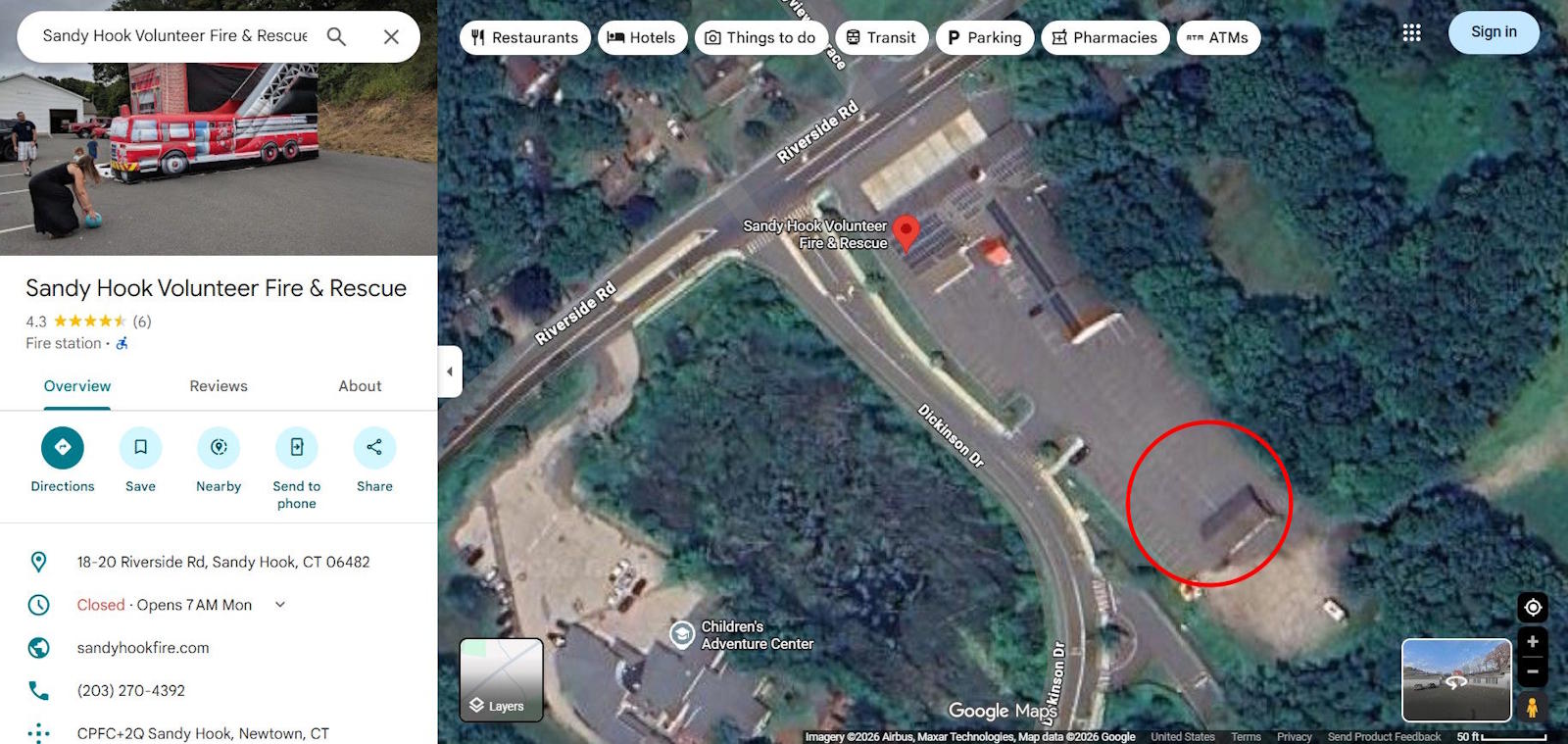
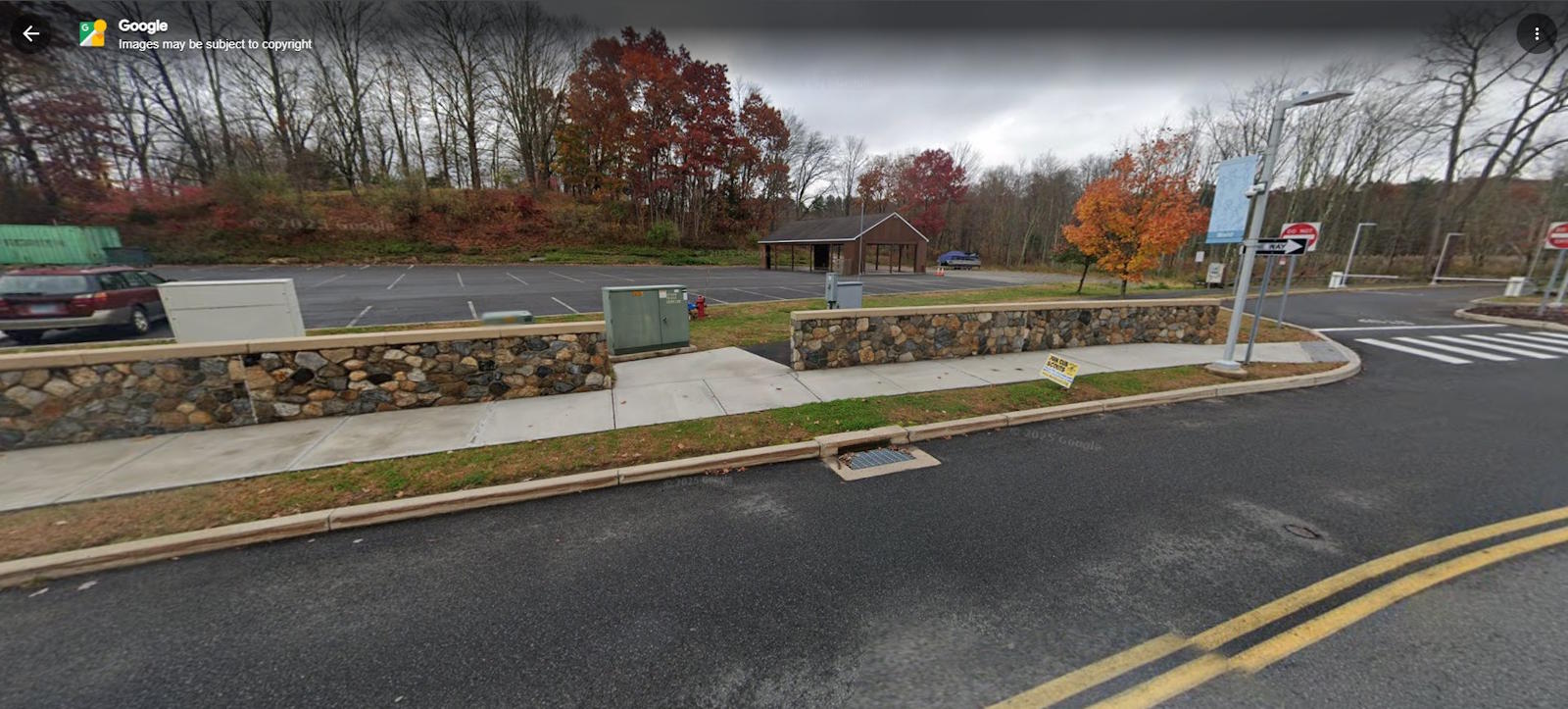
They claim the scenery in one drill photo doesn’t match the scenery in another. This is a manufactured problem. The evacuation photos were taken just outside Sandy Hook Elementary’s front entrance—where Shannon Hicks was standing when she took them—while the fire drill continued behind the Sandy Hook Volunteer Fire & Rescue building, where the students ultimately walked, lined up, and were photographed for Hochsprung’s tweet. The structure visible behind the children in Hochsprung’s photo is the same structure visible behind the firehouse on Google Maps—a fact that’s obvious once you bother to look:
Not everything involving the school happens in one tightly cropped patch of pavement.
The more important question is why the original source is never provided. Why not link directly to Hochsprung’s actual Twitter timeline?
Because they can’t. The moment readers see the full feed—weeks of mundane, verifiable posts showing classrooms full of students, staff events, assemblies, rehearsals, and daily school life—the “closed since 2008” narrative disintegrates instantly. Selective screenshotting is the only way the claim survives.
On October 9, 2012, Hochsprung tweeted a photo from a Pathways to Common Core conference. While the image itself isn’t inside the school, the event is independently corroborated by the November 2012 Newtown Public Schools Superintendent’s Newsletter, which includes the following statement from survivor Natalie Hammond:
“Nobody Died At Sandy Hook” Chapter Eleven By: James Fetzer and Kelley Watt
When I saw the title of this chapter—“Are Sandy Hook skeptics delusional with ‘twisted minds’?”—I thought, Perfect. Easiest chapter yet. I’ll just write “yes”—or “yes, of course,” if I’m feeling loquacious—publish it, and move on to Chapter Twelve.
Unfortunately, there are actual claims being made here. Most are the same recycled nonsense we’ve already slogged through in earlier chapters, but a couple of new wrinkles are tossed in for variety.